



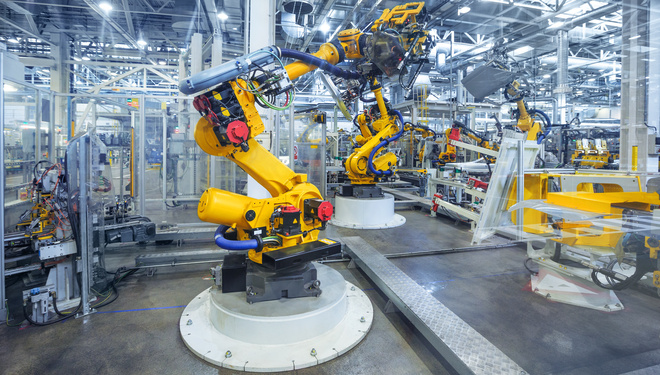
It is estimated that by 2030 from 75 million to 375 million employees (from 3 to 14% of the global workforce) will have to consider the change of their professions. Will global automation become an opportunity to obtain new skills and transfer the hardest work to machines?
McKinsey&Company in their report released in December 2017 estimates that approximately 375 million employees from all over the world will be forced to transform their professions and acquire new professional skills by 2030 as a result of the rapid work automation. Does it mean that the most jobs will disappear from the market?
The authors of the report emphasize that thanks to available technologies, half of the professions performed by employees can be automated. It doesn’t mean that workers will lose their occupations, at least not in all cases, but only that professions will evolve with changes taking place in work environments. It is worth referring to the history, which shows that fears of technological changes are unfounded. Good examples could be the production line, mobile phones and laptops. Nowadays, nobody can imagine life without these things, but while launched their were so revolutionary that they raised fears about the changing labor market. The perfect punchline of these events is the statement „creative destruction” used by Joseph Schumpeter in the 1940s, which combines at once elimination of some jobs with creating new ones.
New age of automation
The era of automation brings hope for change, but also challenges. Speaking of hopes it is worth noticing that automation can reduce time and cost of work. Authors of the report convince that new technologies will reduce from 9 to 26% the working hours (depending on the country). Machines can perform tasks that are routine or dangerous. New age of automation may enter into force fluently if workforce will be prepared for comprehensive changes. It implies the emphasis on new abilities, increase training, in particular for middle-aged workers. An important issue is also the education reform. Educational institutions must prepare potential employees in an appropriate manner, including through digital technologies that enable creating more individual learning paths for student and preparing them to enter the automated labor market. It is important to establish the interconnectivity between business and science, because the current situation is unsatisfactory. To maintain the balance on the labor market it is necessary to provide the employees with appropriate qualifications. In addition, the rate of re-employment dismissed as a result of employee automation (if within maximum a year) will not cause imbalance on the labor market.
Automation vs new professions
Changes caused by automation will certainly contribute to transformation or complete disappearance of some professions, and what is more important to creation of new positions, which at that moment may be difficult to imagine. Some of occupations can’t be mechanized because they are based on soft/interpersonal skills, which means that they require creativity and empathy which machines are unable to produce at that moment. Trades based on interpersonal contacts are primarily health care (particularly important in the context of aging society), industries based on specialist knowledge, managers whose work can’t be replaced by robots, however a partial scope of duties could be automated (collecting information, analyzing data or preparing reports).
How does the technological change shape the labor market in Pomerania?
The Pomeranian labor market is also a subject to further automation – it is an inevitable process. Branches with high investment potential are primarily modern services for business, IT, maritime industry (both shipbuilding and logistics), electronics.
A forerunner of the change to come has been presented at the International Technology, Innovation and Automation Fairs in the Industry in Hannover Messe 2017. The Pomerania Region in April was represented by 11 companies. Examples of projects included: a Cartesian robot, machines for trenchless piping under pavements, streets and gardens, an IT system that automates the production planning process and measures its performance in real time, a lifeboat simulator and many more. Definitely the Pomeranian market will also undergo further automation processes. In a wider perspective, it is possible to anticipate the creation of new jobs, in particular in areas based on IT and programming as well as R&D industries.
Will the global economy create enough additional occupations?
In the forthcoming era of automation, it will be necessary for the government and companies to create a balance between the use of new technologies and the changes it will bring. After a deep analysis of issues related to the process of implementing new technologies, the authors of the report made the statement that automation will be an engine of growth for the productivity of the national economy. Politicians, businessmen and employees will have to show flexibility, creativity and even visionary in order to adequately implement the upcoming changes in force. The growth of production potential should be rationally adjusted to the existing staff and the demand for more products. Otherwise, the potential created during the revolution will be unfounded and will contribute to unemployment.